Bleach Bypass
A Guide for Film Photographers
8 min read by Dmitri.Published on .

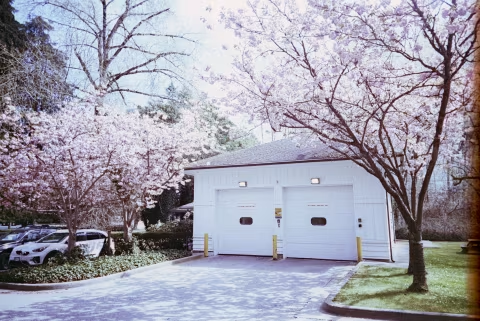
Bleach bypass is a relatively simple film development technique that creates rich blacks, low saturation, and increased contrast.
You may recognize the bleach bypass look in English-language movies like Minority Report, Se7en, and Fight Club, but it was pioneered by Kon Ichikawa in Japan for the 1960 movie Her Brother and is still used in many international films.
However, this technique is fairly uncommon for us, still photographers. This guide aims to change that!
Sometimes called skip-bleach or silver retention, this technique works with colour-negative films developed in both C-41 and ECN-2 chemistries with separate bleach and fix. A minimal change to the process — removing the bleaching step — does the trick, but it can be tough to master, as it affects exposure and dynamic range to varying degrees.
In this article, I’ll share techniques, samples, and recipes for better bleach-bypass results on film.
Prerequisites: You will need to know how to develop colour-negative film at home (it’s not that hard!) and have a development kit with separate bleach and fix (no blix) or an extra black-and-white fixer.
In this guide: How does it work? The photochemistry of bleach bypass. Bleach bypass at various stages of film development and printing. How to expose for bleach bypass. Picking the right scenes for bleach bypass processing. Developing C-41 film via bleach bypass. Scanning bleach-bypassed film. Support this blog & get premium features with GOLD memberships!

How does it work? The photochemistry of bleach bypass.
During colour-negative film development, the bleaching step removes silver from the highlights (dark areas on a negative), leaving only the dyes. This adds colour and definition to the bright areas of the scanned image, thanks to the semi-opaque coloured molecules that make up the dye clouds.
While silver crystals are essential for forming black-and-white film negatives, they cannot produce a clean, colourful image. Instead of allowing a specific wavelength through (red, green, yellow — the job of the colour dyes), silver crystals either block or pass the entire spectrum of light, creating a range of shades from black to white only.

However, bleach bypass does not turn colour-negative film black-and-white. Instead, it becomes a mix of the two, with the remaining silver crystals behaving in a monochrome fashion while the remaining developed colour dyes continue to render colours.
As you would imagine, mixing colour and monochrome tones in the same image decreases its saturation. And since we’re dealing with negative film, adding black-and-white and colour images together also creates stronger (brighter) exposures.
What I think makes the bleach bypass process particularly interesting is that it can have various effects, depending on the film that you use. For example, the new Harman Phoenix film is virtually unaffected by the process, whereas films like Kodak Ultramax will change significantly, turning deep reds orange and creating a much starker overall appearance.
The variability in the results may give you a new look for the film you’ve already shot. But if not, you can save a few minutes developing film, which is an advantage in itself.

Bleach bypass at various stages of film development and printing.
Bleach bypass can only work with colour-negative films. Black-and-white negative films have no bleaching step (so no difference), whereas reversal (slide) film would come out black and unusable if you were to skip the bleaching step.
Still, there are several ways you can apply this effect to the image-making process.
Like colour-negative film, RA-4 paper for colour darkroom prints can also be put through bleach bypass for a similar effect. Some photographers claim that this method can save underexposed negatives.
Movie studios typically reserve the bleach bypass stage for the internegative step of production, which is one of several duplicate copies of the film in the analogue movie distribution process, leaving the original camera film normally developed. This gives the director a choice of effects and a better chance of preserving the very expensive master rolls.