In Praise of the Humble Ricoh Diacord
What Makes a Good TLR and Why Ricoh Are the Sleeper MF Cameras of 2026
8 min read by Howard Sandler.Published on .

The year was, I think, 1975. I was in grade 8 and on a school photography club outing. I remember feeling somewhat embarrassed to be using my father’s boxy 1950s TLR, the Ricoh Diacord L.
In fact, I remember another student, sporting an Olympus OM-1, calling it a “shitbox.” Soon after that, although I hauled the Diacord all through a family trip to Israel, I convinced my father to spring for a 35mm SLR and forgot about the Diacord for decades. We eventually gave it to my nephew.
In this article: Why a TLR is a must-try for medium format. The three tiers of TLR lenses. TLR film-winding mechanisms. The TLR focus ergonomics. Metering with TLRs. Other TLR features. Ricoh Diacord: a slept-on TLR. Support this blog & get premium features with GOLD memberships!
Fast forward to 2013, and I was by then a digital SLR veteran, earning some money with my digital equipment, but beginning to be interested in film again for my own fun. After going through a few 35mm film rangefinders and SLRs, I noted two things: first, 35mm film SLRs, at least the more modern plastic-bodied autofocus models, tended to handle so much like digital SLRs that the experience of using them was not satisfyingly different. Second, you need a really good scanner to pull enough detail out of a 35mm film frame to approach a good digital image in some key image qualities.
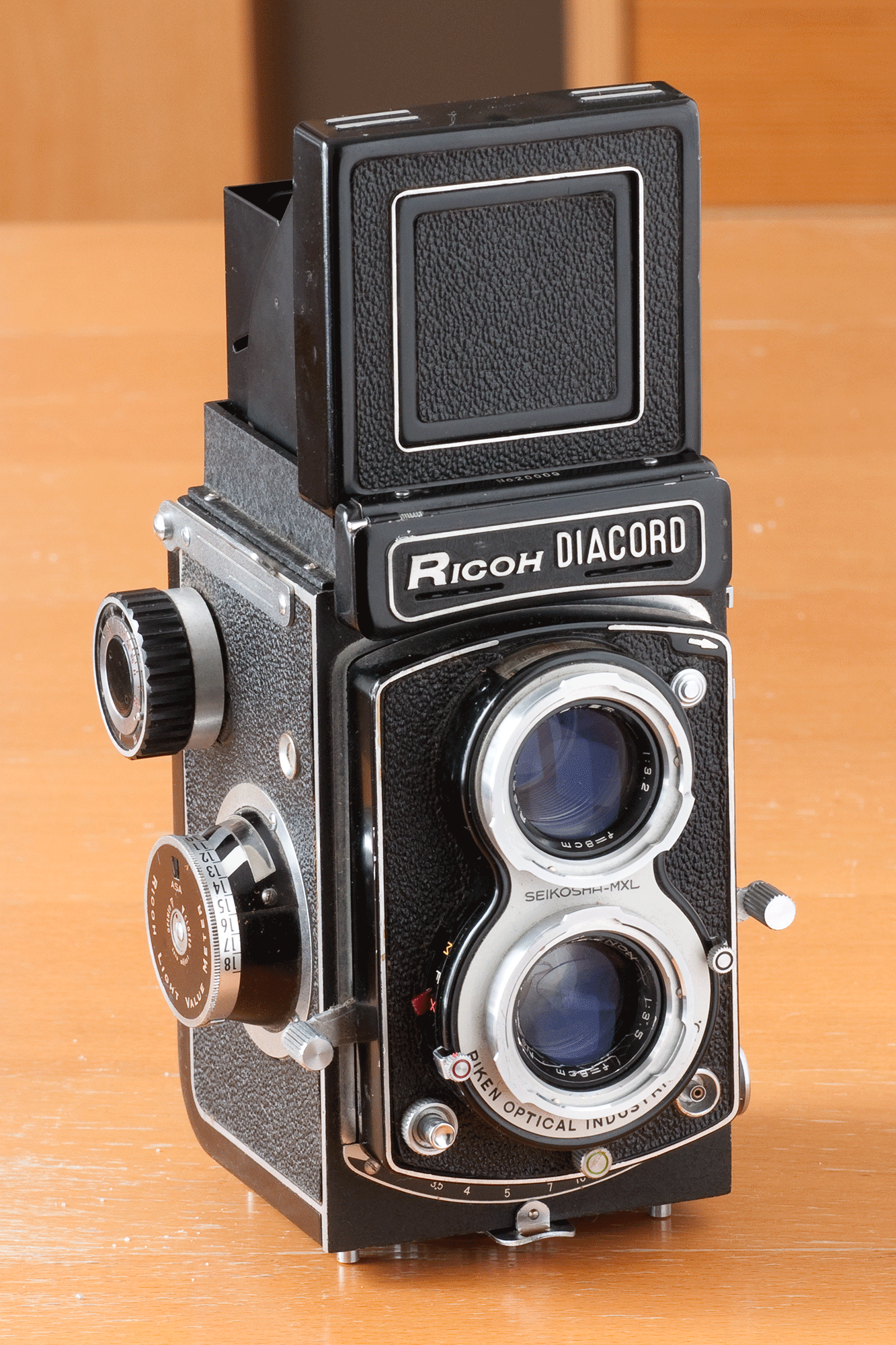
I wanted to play in medium-format again, but this time purposefully and unapologetically. A Diacord L — the exact model I had used all those years ago — came up on the local buy-and–sell website in Ottawa, so I bought it for old time’s sake.
The camera immediately felt familiar in my hands, even the way the spring tension increases as you pull the shutter cocking lever to the right for the Seikosha shutter. The muscle memory had never been lost!
Unfortunately, the camera was dirty and had a sticky shutter. I attempted to take the lens elements apart to douse the shutter in lighter fluid and ended up getting some gearing misaligned, so the actual aperture didn’t match the readout and would not open beyond f5.6.
I sold that Diacord, but even as my armoury of other medium-format cameras increased, I wanted to have a Diacord again. A couple of years later, a suitable candidate came up on eBay, so I bought it, again the same model my Dad had bought around 1958.

Why a TLR is a must-try for medium format.
I think just about anyone who shoots medium-format should have at least one TLR. It is a different experience from just about any other type of camera.
First, the frame is square. Even if you think that’s just a convenience so you don’t have to tilt the camera to shoot verticals, and that you will crop your frames later, I think you will find yourself composing to fill the square, making more square images, and liking it.
Second, the experience of composing with both eyes open, looking at a ground glass screen, is unique. Everything seems more 3-dimensional. I like to just walk around looking at things through the viewfinder.
Third, the mirror doesn’t flip. You can see any blinks at the instant of pressing the shutter, and you can hand-hold the camera at relatively slow shutter speeds. The separate taking and viewing lenses are also nice when you are using filters, especially for infrared photography, as they don’t obscure your view.
The three tiers of TLR lenses.
Okay, let’s say I've convinced you that TLRs are a good thing. Is the Diacord a good model to consider? Definitely yes.
As TLRs go, there are essentially just a few features that differentiate one from another. Here’s how the Diacord stacks up:
First, consider the lens. The top tier in TLRs, the Rolleiflex models, have multi-element Planar or Xenotar lenses, which are known to be superb.
The next tier down includes the Rolleicords, the Yashica-Mats, Autocords and Diacords. These all feature four-element Tessar-formula lenses. I only have personal experience with the Autocord Rokkor 75mm lens and the Diacord Rikenon 80mm lens. I find both of these excellent.
There is another tier across all these brands, generally from the mid-50s or earlier, which used three-element lenses. In the Ricoh line, the three-element lens models were called Riconars.
TLR film-winding mechanisms.
While the Rolleiflexes, Yashica-mats and Autocords have crank-winding mechanisms which also cock the shutter, the next tier, which in the Ricoh line included the Diacords, had a knob-winder with auto-stop at the next frame. You have to manually cock the shutter for each shot.
I’m happy enough with that; in fact, I would be satisfied with a red window. Less to go wrong. I also find the pull-to-the-side cocking lever of the Seikosha shutter to be haptically satisfying for some reason. It’s also handy for loosening up a sticky shutter with the lens cap on before taking the real shot. There are also Diacord models that had a Citizen shutter with a different cocking lever.
The TLR focus ergonomics.
Here I assert that the Diacord has the most wonderful focus control of any TLR.
A unique see-saw, which Ricoh called the “Duo-lever,” lets you place your two thumbs on either side of the lens board and push down on one side or the other to adjust focus.
See the animated GIF (above) to see how it works.

Metering with TLRs.
The Diacord L model had an uncoupled selenium meter. The cell is behind the nameplate on the front and has two ranges.
When the nameplate covers the cell, two slits expose just a small fraction of the surface to light, so it reads in bright light. When the cover is flipped up, the whole cell is exposed, so it reads in dim light. Simple and smart!
The meter needle is read from a window on a circular calculator on the right side of the camera. The meter reads out in LV units — common in the late 50s — which you manually transfer to shutter speed and aperture settings using the readout scales above the viewing lens.
Everything is viewed by looking down from above. The meter in mine still works, although not so accurately in dim light.
If you don’t care about a built-in meter, the Diacord model G comes without one, but be careful, as some earlier versions of the G have the simpler Riconar lens.
Other TLR features.
Finally, there are some features of TLRs that are usually not deal-breakers, but are worth considering.
The Diacord has a hot shoe, which I think was rare in 1950s cameras. My model, which has the Seikosha MXL shutter, also has a self-timer.
The shutter button of the Diacord, as with Yashicas and the original Nikon F, is not drilled and tapped to accept a modern cable release. You have to obtain a “Leica nipple,” a small accessory that screws into threads that surround the shutter release sleeve, and then attach your cable release to that.
Ricoh Diacord: a slept-on TLR.
I’ve used my Diacord out in -20℃ (-4℉) weather, and the shutter was still reasonably accurate. When I carry it on the street, it always attracts comments — no, not “is that a Rolleiflex?,” but more like “what is that?”, “cool!”, “old school!”, and “Is that a movie camera?”
At the moment, the Ricohs are the sleepers of the TLR world. You can find a serviceable one on eBay for under $200 USD, then consider cleaning it up yourself or sending it for a clean lube adjust if it’s too grotty.
Really, as long as the lens is not full of fungus and the shutter works at all, there’s not much else to go wrong. I would recommend getting a lens hood, as the lens front element is only single-coated and not deeply recessed.
There are very inexpensive plastic lens hoods that use the Bay 1 filter mount; however, you can’t also mount a filter with those. For a bit more money, you can get a metal lens hood that mounts over the outside of the Bay 1 bayonet, and this allows you to also put filters on the inner bayonet.
Coming full circle, I’ve returned to my photographic roots.
❤ By the way: Please consider making your Ricoh Diacord TLR film camera purchase using this link so that this website may get a small percentage of that sale — at no extra charge for you — thanks!
