InvisibleFilm
Building a Digital Home for Analog Photography
6 min read by Fugazante.Published on .

Hi there! My name is Gonzalo. I am a co-founder of Fugazante Creative Code Lab — a small creative technology studio focused on building digital tools for independent artists and communities. Over the past few years, I’ve worked on projects supporting digital art initiatives and creative organizations.
But outside of work, I am also a film photographer.
From passion to project.
Like many people who shoot analog today, I quickly ran into the same challenges: keeping track of film stocks, remembering which camera was used for which roll, organizing scans, archiving negatives, and communicating with labs. The process was often fragmented across notebooks, folders, spreadsheets, and memory.
At the same time, I noticed something interesting. Film photography is experiencing a strong resurgence, but many of the tools used to support it — especially in lab workflows and film archiving — still rely on outdated systems.
I began to wonder what would happen if modern digital infrastructure were designed specifically for the needs of analog photography.
That idea eventually became InvisibleFilm (@invisiblefilm.io on Instagram).
Designing a platform for the entire film lifecycle.
InvisibleFilm is a cloud-based platform designed to support the full lifecycle of analog photography — from loading a roll of film into a camera to archiving the final scans.
The platform is accessible through a web interface and mobile apps for iOS and Android, allowing photographers to document, organize, and preserve all the information that surrounds their film work.
Film photography generates much more data than I often realize. Film stock, exposure conditions, camera and lens combinations, development methods, scanning workflows, and locations all contribute to the story of a photograph. But because the medium itself is physical, these details are often scattered or lost over time.
InvisibleFilm aims to keep all that information connected.
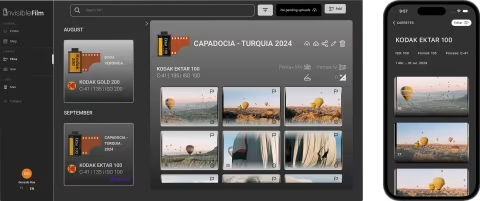
A personal film archive.
At its core, InvisibleFilm allows photographers to create a structured archive of their analog work.
Users can register their rolls of film and attach detailed information such as:
• Film stock and format
• Camera and lens used
• Shooting notes and conditions
• Date and location
• Scanner
• Digital scans associated with each frame
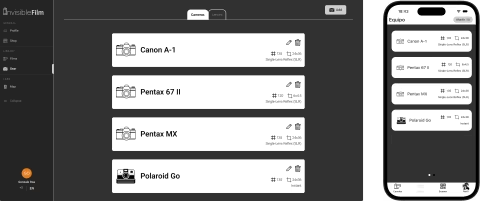
The platform also allows photographers to catalogue their equipment — cameras and lenses — and link them directly to their rolls.
Over time, this creates a searchable archive of a photographer’s analog practice.
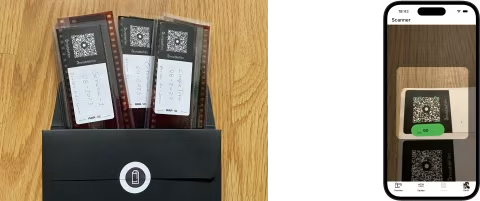
Keeping the negatives and data connected.
One of the most difficult parts of analog photography is maintaining the connection between a physical negative and its digital representation.
To address this, I created a system of unique identification tokens — small adhesive labels with unique codes that can be attached to film sleeves or storage sheets. Using the mobile app, photographers can simply scan the code and instantly access the associated data, scans, and notes for that roll.
A public film stock database.
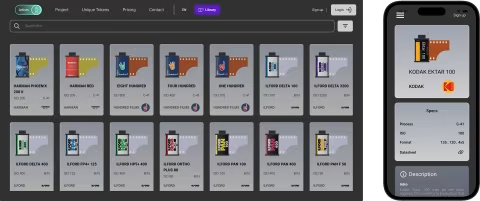
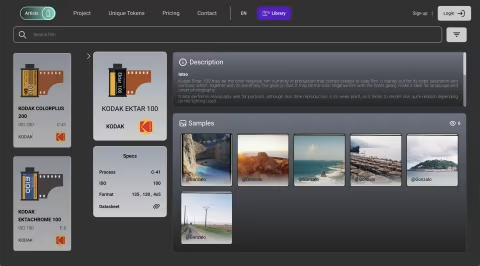
One of the most important contributions to the community is the public film stock library. It is a structured, open catalogue of film stocks where the community can find information like tips, samples and the history of their favourite films or discover new ones. One of the most important features is that the film database is totally open, so anyone can contribute to it by suggesting new film stocks or proposing changes to the current ones.
The public film library is completely integrated with the private side of InvisibleFilm, which means that any roll that you have created in your private archive can be linked to a well-known film stock, allowing you to access very quickly all the information about this kind of film. Optionally, you can also share some of your private images as public samples, contributing to the community with your own work.
Film labs — the other side of the coin.
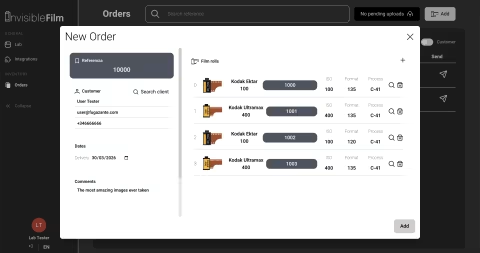
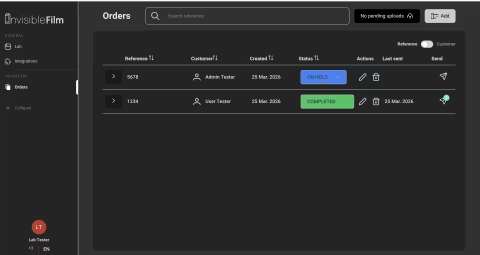
From the very beginning, I thought of InvisibleFilm as a platform that could be present during the full life cycle of analog photography, and that cycle cannot be understood without including the film labs. These (in most of the cases) small businesses are part of the process for many amateur and professional analog photographers, and they are facing the same challenges. They have to use a lot of software tools that are totally deprecated, which usually limits the efficiency of the workflow and the quality of the results.
InvisibleFilm — for film labs, allows labs to manage the complete lifecycle of customer films — from reception to development, scanning, and final delivery. It integrates with e-commerce platforms and provides automated tracking so photographers can see the status of their film.
I’ve also built tools to integrate with scanning workflows, including desktop applications with hot-folder synchronization and compatibility with Lightroom.
At the end, closing the circle, when the users receive their work from a filmlab that is using InvisibleFilm, they are able to import it easily to their private archive.
Looking ahead.
InvisibleFilm is now a production-ready platform actively used by photographers and labs. But the project is still evolving.
Film photography has always been about more than images.
It’s about the physical process, the waiting, the craftsmanship, the unpredictability, and the communities that grow around it. But it also increasingly lives in a digital environment — through scans, archives, editing workflows, and online sharing.
InvisibleFilm exists somewhere between those two worlds.
My hope is to build a digital space where the information, processes, and memories around analog photography can live together — without losing the tactile beauty that makes film photography unique.
Website: invisiblefilm.io
Instagram: @invisiblefilm.io
