Lighting Ratios & Styles for Film Photographers
The Science and the Techniques for Effective Storytelling on Film
14 min read by Dmitri.Published on .

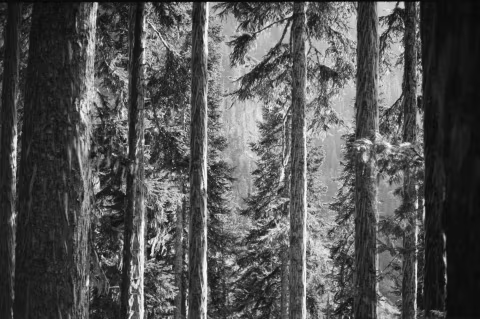
Light has been used as a storytelling device long before photography was invented. Its significance is even evident in writing where no image, other than what the mind paints, exists: “a bright sunny day” carries a different mood than “a dark alley.”
Several scientific studies even link lighting in photography to measurable mood changes, suggesting that their effects are universal and innate. Clearly, an essential part of an image, light can be used to convey emotional elements of a story (which, in itself, has been proven to be a key component of an impactful image).
In this guide, I’ll focus on fundamental techniques for using lighting ratios as a storytelling device, observed on sets and in the field by movie studios and hobbyist photographers alike.
To benefit from this guide, you only need your camera and an eye for detail.
In this guide: What is a lighting ratio? How to measure lighting ratios. Five lighting styles based on ratios. “Normal” lighting. “High-key” lighting. “Silhouette” lighting. “Low-key” lighting. “High-contrast” lighting. The science behind the lighting styles and their effectiveness for storytelling in photography. Composing lighting styles with natural light. Composing lighting ratios with flash. Composing lighting ratios with artificial light, reflectors, and modifiers. Picking the right film for your lighting style. Emphasizing lighting ratios with film development choices. Emphasizing lighting ratios with edits. Emphasizing lighting ratios by curating key/fill reflectiveness. Altering lighting ratios with lens selections, filters, and effects. Support this blog & get premium features with GOLD memberships!
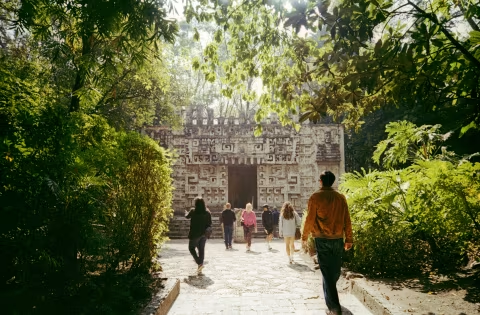
What is a lighting ratio?
Before we talk about lighting ratios, let’s quickly define key and fill, the fundamental components of light composition:
Key: Light pointed at the subject or the object in focus.
Fill: Light pointed at the rest of the scene.
If you’re shooting using ambient light (no flash, no lighting setup — just the camera), your key light could be the sun or a streetlight, whereas your fill could be the indirect light in shaded areas.
In a studio or under controlled light, any light that isn’t pointing at the subject or the object in focus (even if it’s the same source) can be considered fill light.
A lighting ratio is a comparative measurement of the key and fill lights’ brightness.
Photographers express lighting ratios as fractions of relative light intensity, such as “4:1,” where the first number represents the key and the second represents the fill light. In this example (4:1), the key light is four times as bright as the fill light.
But to truly understand what those ratios mean, we first need to learn how to measure them.
How to measure lighting ratios.
You can measure your lighting ratio by taking light meter readings from your key and fill areas.
If your light meter provides EV values, you can calculate your lighting ratio by raising 2 to the power of the difference between those values:
LR = 2 ^ (EVk — EVf)
Where LR is the lighting ratio, EVk is the light meter EV reading for the key area, and EVf is the light meter reading for the fill.
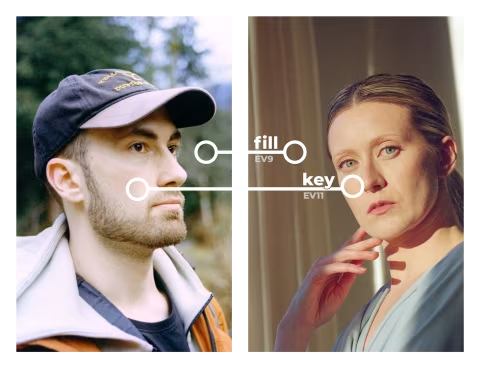
For example, if pointing your light meter at the key area reads EV11 and the fill is EV9, your lighting ratio will be 2^(11-9) = 4 or 4:1.
If your EVk is darker than the fill (when, for example, photographing a silhouette), your lighting ratio may look like this:
2^(11-13) = 0.25 or 1:4.