Polaroid Reclaimed Purple 600 Film Review
Review, Shooting Tips, the Original Blue Comarison, and How to "Make" One Yourself
8 min read by Dmitri.Published on .

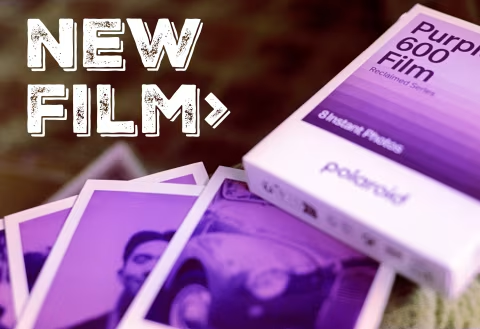
Polaroid Reclaimed Purple 600 is an instant film made with “leftover” materials to produce a truly unique look — this time with added Acid Red dye.
The film’s purple colour effect is both creatively and technically fascinating — I’ve enjoyed shooting it — but there are some things you should know before you expose your limited-edition frames.
This is my detailed overview of these stark new Polaroid frames, with samples, a few extras (including that one time I accidentally created a similar purple effect on Instax Square), and tips for getting better exposures.
In this review: What is a “reclaimed” Polaroid film? Polaroid Reclaimed Purple vs the original Reclaimed Blue. My accidental Instax Square “Reclaimed Purple” frame. The Reclaimed Purple colour. Exposure guide. Which cameras can use this film? Further reading. Where to buy. Support this blog & get premium features with GOLD memberships!

What is a “reclaimed” Polaroid film?
Today’s Polaroid is the only instant film company that makes experimental dyes and injects them into its frames. Even before it was resurrected and transformed from an enormous conglomerate to a single facility by the Impossible team, Polaroid was offering a high-quality range of options — yet never as eccentric as today’s lineup of wild colours and frame designs.
The best-known colourized Polaroid frames have been the Duochrome series. They are black-and-white films with dyes that create dim, eccentric images. But the Reclaimed series is different.
Polaroid Reclaimed frames use colour negative film layers with their cyan, magenta, and yellow fully intact. However, the colour layers are out of spec and can’t develop an accurate image. So the Polaroid chemists came up with the idea of replacing the colour developer in those frames with TBHQ.
Tertiary butylhydroquinone is used to produce monochrome photos, but in this case, it creates a mix of both: colour film with a black-and-white developer.
The first iteration of this experiment was the Reclaimed Blue film, which produced a range of colours from the nearly opaque blue in the shadows to white in the highlights. When that film launched, I measured its dynamic range, which appeared nearly as good as that of full-colour photos and certainly better than the Duochrome films. In other words, this film had a wider tonal range, making it easier to get good photos.
The subsequent Reclaimed updates used the same exact method — out-of-spec colour negatives with TBHQ — but added dyes to create a new colour. Unfortunately, adding a dye cuts the highlights, reducing the dynamic range, and making the film behave a little more like the Duochrome — stark and flat.
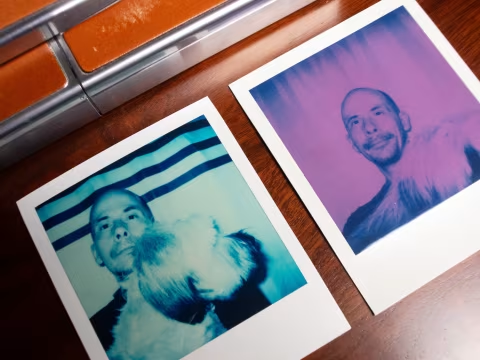
Polaroid Reclaimed Purple vs the original Reclaimed Blue.
Polaroid rarely re-releases its previous special-edition films, which makes the Reclaimed Purple a film worth keeping in a fridge for a rainy day. It may never come back.
The original Reclaimed Blue frames are extremely expensive on the used market. If you want to try some, get ready to dish out a few hundred bucks for the world’s last remaining supplies.
Above is my comparison of the two films — shot in the same light, with the same camera and settings. The original Blue indeed looks brighter, with a bit more tonal range, though the Purple is still a very pretty film and is just as fun to play with.
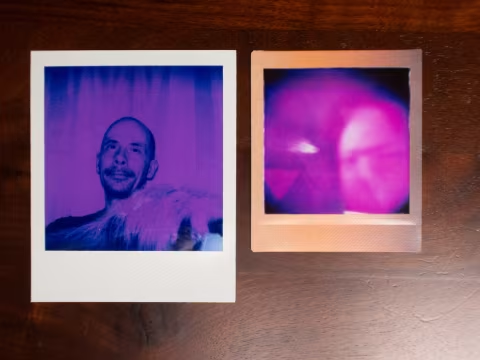
My accidental Instax Square “Reclaimed Purple” frame.
The colours of the Reclaimed Purple Polaroid film are truly unique, though they aren’t completely impossible to approximate. Lighting your scene with purple flash or shooting through a filter could create something similar (but you’ll need to use colour film).
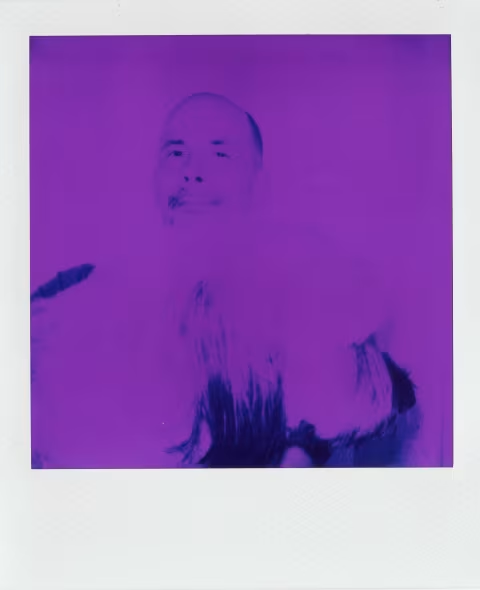
Years ago, I developed an Instax Square frame that looked very purple while I was working on a lens made entirely of sugar for the world’s first edible instant film camera. A combination of long exposure, my purpleish plant lights, and the distortions created by the sweet, sweet optics made a funky portrait that I immediately thought of when I saw my first Polaroid Reclaimed Purple 600 result.
Not the same thing, though, I still think it’s neat.
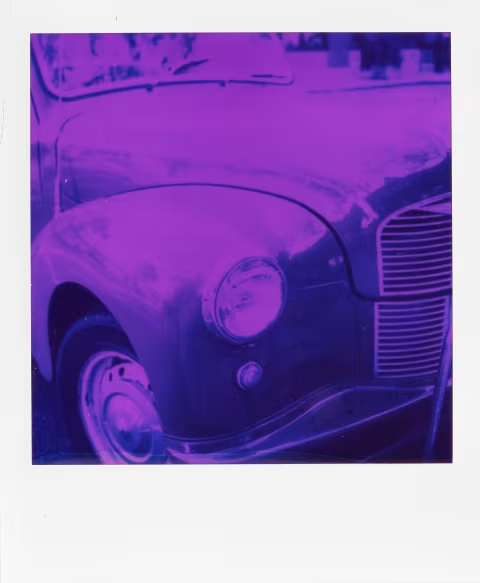
The Reclaimed Purple colour.
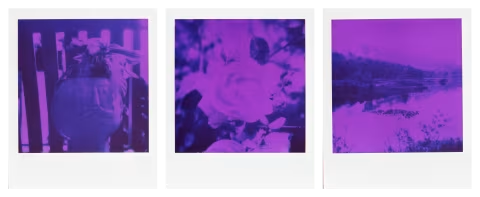
I did my best to scan and colour-correct my fresh Reclaimed Purple frames. I think that on most screens, the results are pretty close. However, printed images, particularly Polaroid, are never statically lit — the colours and the brightness of the frames will change depending on the lighting and the angle you’re looking at them.
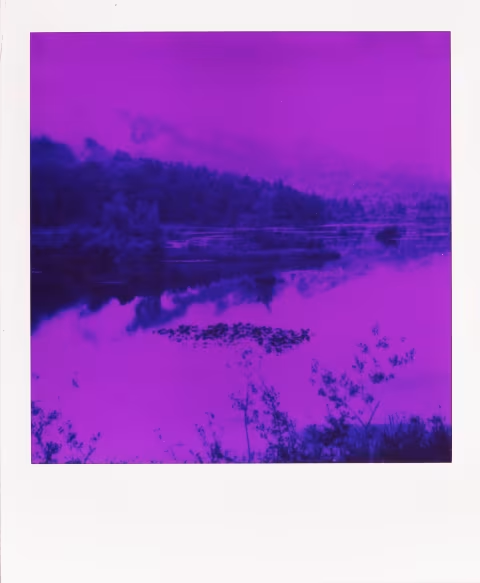
The highlights of the Reclaimed Purple are nearly red. They look warmer under the bright light — cooler when dimmed. The midtones and shadows are much bluer, with the deepest blacks still retaining some colour.
Many of the samples I’ve seen online look dark, darker than I’d expect the actual frames to appear in-hand, but also less purple and more blue. Perhaps the built-in colour correction in the scanners used is getting tripped up by the unusual Purple palette.
I’ve added some brightness to my scans to simulate what I’m seeing under colour-balanced light, and adjusted the tones to better match the frames.
Exposure guide.
The Reclaimed Purple film shares a limitation with the Duochrome series, as it does not render pure whites. The brightest highlights are already purple, which may make it tempting to overexpose for brighter images. However, this film can not be any brighter than purple. Adding too much exposure can yield nearly blank frames.
Of course, the “blanks” will still have that signature purple dye, so having one or two may not necessarily cause a complete disappointment.
Still, for the best results, I think it’s important to ensure that your exposures are correct, which may require some experimentation.
I’ve shot mine in my unmodified SX-70 Model 1, with MiNT Flash indoors or with the L/D wheel nearly all the way towards the dark outdoors without flash (I’ve also made sure there’s some backlighting to force the camera to reduce the exposure even more). If you have a camera that works well with 600-series film or a modified SX-70, set the exposures to the middle.
Lastly, because this film is relatively sparse on details and very high in contrast, scenes with minimal, clean lines and fewer fine details may yield better images. Busy scenes don’t seem to work well with this or any of the Duochrome series.
One way to make your scenes less busy with cameras like the SX-70 or the I-2 is to create bokeh by standing close to your subjects and shooting in a lightly subdued light.
Which cameras can use this film?
The Polaroid Reclaimed Purple 600 film is compatible with all the 600-series Polaroid cameras, including the new I-Type cameras. It comes with a battery, which makes it compatible with nearly everything that fits the integrated Polaroid packs — including the SX-70 cameras (either with a MiNT Flash Bar or via the backlight technique, see below).
Further reading.
For more info on Polaroid colour film development times, sharpness/resolution, frame size, scanning techniques, and safe ways to recycle the packs, follow the links above. If you’d like to learn more about the brand, check out “A Brief History of Polaroid.” Also, see my review of the original Reclaimed Blue film for more technical details about this medium and a dynamic range estimation.
To make the photos you see in this article, I used MiNT Flash Bar II at half-brightness with my unmodified Polaroid SX-70 camera and the backlight exposure technique.
Where to buy.
This film is almost exclusively available on the Polaroid website. You will need to subscribe to become a member (it’s free, and the marketing emails are nicely sparse, plus you get a discount). Some shops like the Brooklyn Film Camera also sell it — but at a markup.
This is a limited edition film. Given how much the Reclaimed Blue packs go for today, you may not get another chance at the Purple edition for this price. If you like it, get it now:
❤ Please consider making your Polaroid Reclaimed Purple 600 film purchase using this link so that this website may get a small percentage of that sale — at no extra charge for you — thanks.
Polaroid’s shipping to Canada was impressively quick — only two days — this is how I managed to get this article ready within a week of the film’s launch (nope, I didn’t get any freebies).
Hope you enjoy this film as much as I did!
