Comparing All (7) ISO 100 Colour-Negative Films
Aerocolor, Fuji (JP), Ektacolor Pro, Ektar, Kodacolor, Pro Image, Lomo
21 min read by Dmitri.Published on .

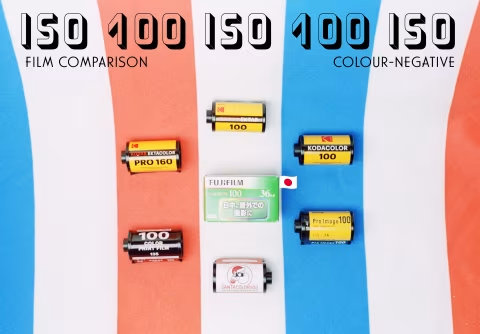
Colour-negative film is extremely difficult to manufacture — there are only six facilities on this planet that can do it today.
Of those six factories, only two make ISO 100 colour-negative film. Kodak makes Ektacolor Pro/Portra 160, Ektar 100, Kodacolor 100, and Pro Image 100. Kodak also makes Aerocolor IV; several brands buy and repackage it under different names. Lomography sells ISO 100 colour-negative film which appears to be made by Kodak, but it’s not Aerocolor.
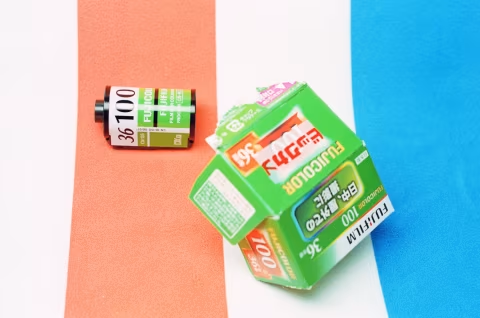
Few people outside Japan know about Fujicolor 100, an ISO 100 colour-negative film that Fujifilm makes only for their domestic customers. I imported a roll just to complete the most comprehensive comparison of all the colour-negative film stocks in the ISO 100 range.
Even though most of the film in this test comes from one factory, it’s not all the same. I’ve covered numerous differences between the ISO 800 colour-negative films (all of which are made by Kodak). That said, the contrast between the Japan-only Fujicolor 100 and the Kodak films is very stark.
This article uses a systematic approach, with one-to-one scan comparisons conducted under full control of the inversion process, to give you the most accurate picture, unclouded by bias.
I’ve shot and reviewed a lot of film over the years, yet seeing some of my daily drivers lined up like that revealed many surprises, like how well cheap films can handle over- and underexposure compared to more expensive stocks or how deep Ektacolor Pro can render reds when underexposed.
In this article: Method. Normal exposures. Overexposure by +2 stops. Underexposure by -2 stops. The big picture. My favourite and least-favourite ISO 100 colour-negative films. Appendix: Film strips and edge markings. Support this blog & get premium features with GOLD memberships!
Method.
Films compared: Aerocolor IV (branded as SantaColor 100), Fujicolor 100 (Japan-only import), Ektacolor Pro/Portra 160, Ektar 100, Kodacolor 100, Pro Image 100, and Lomography Color Negative 100.
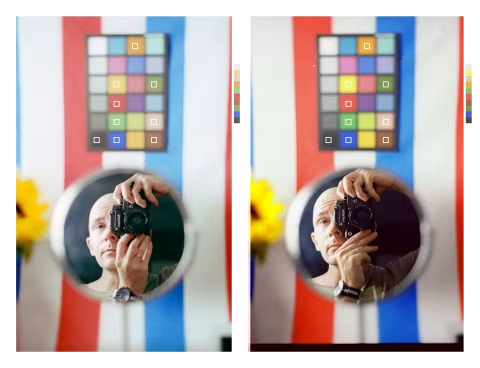
For each of the films, I aimed for identical exposure and framing under the consistent lighting of my Amaran F21x. I focused on my face in a mirror selfie, as skin tone is typically the most telling indicator of the image quality¹. I’ve also included a Datacolor Spyder Checkr chart for direct swatch comparison and built the still-life scene to include some primary colours.
Because some of the exposures required taking a shot at 1/30th and f2.0 (without a tripod) with a 50mm lens at short distances, I took several takes to make sure I got the focus, framing, and motion blur under control. In total, I’ve shot and developed 66 frames on 7 strips of film. I then picked 21 best representatives from each strip for this experiment.
Exposure settings: I wanted to get a range of visually significant exposure changes on all films. As in my previous experiments, I underexposed and overexposed each by two stops in addition to normal exposure. Over- or underexposure by a single stop can be very hard to spot on modern colour-negative films, whereas doubling that makes identifying candidates easier and exposes more strengths/weaknesses from each stock.
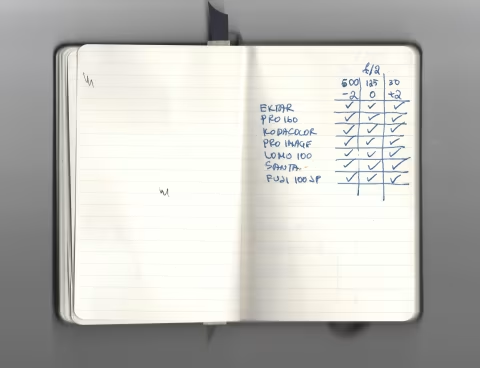
For this experiment, I decided to keep my aperture constant and only change the shutter speed. Though it made some shots more difficult and left the colour chart largely out of focus across all frames — I believe doing so added consistency to the images. The colour chart does not have to be in focus to be useful; in fact, the blurring smoothed out imperfections in the middle of each swatch.
Kodak Ektacolor Pro 160 (formerly sold as Portra 160) is not exactly an ISO 100 film, but I treated it as such for this experiment. I wanted to have as broad a sample as possible and to provide additional context. I’ve shot this film using the same exact settings as the rest of the emulsions:
f2.0 1/500s for -2 underexposure, f2.0 1/125s for normal exposure, and f2.0 1/30s for +2 overexposure. Normal exposures were measured against the colour chart’s 18% grey mark.
I developed everything in a new set of Flic Film C-41 16 Roll Pro Kit chemicals (skipped stabilizer).
All film was scanned on my Nikon SUPER COOLSCAN 5000 ED with VueScan as positives using neutral settings (autofocus and autoexposure were left on). The 16-bit TIFF scans were then inverted with film Q and colour-corrected (with particular attention to preserving contrast) using greyscale masking over the colour chart.
To ensure we’re looking at differences between film stocks rather than changes in exposure or scanning artifacts, I’ve matched the grey bars on the colour charts, including their apparent brightness.
Though consistent, my props and lights don’t cover all the possibilities of using those films in the real world. I’ve shot all of these films (except Fujicolor) in the field — I’ll share the relevant bits below.
Caveats. This is not a blind or double-blind study. I’ve used fresh films with expiry dates at least a year away, yet I can not know the transportation or storage conditions. I don’t have any insights into changes between the production batches.
¹ — Shimakura, Hitomi, and Katsuaki Sakata. “Color Criteria of Facial Skin Tone Judgment.” Vision Research, vol. 193, 2022.
Normal exposures.
If you’re good at finding Waldo, you know that methodically scanning smaller patches of a picture can be a lot more productive — which is how I’d like to approach this comparison. Instead of dumping all the scans on you at once, I’ll compare them in six groups — two for each exposure range.
The first group of films for normal exposures — metered for 18% middle grey against the colour chart — comprises Kodak Aerocolor IV, Fujifilm Fujicolor 100, Kodak Ektacolor Pro 160, and Kodak Ektar 100. This is the most diverse group of films: Aerocolor is a professional forestry/aviation stock; Fujicolor is the only film on this list that isn’t coated by Kodak; Ektacolor Pro is slightly more sensitive than ISO 100; and Ektar is a uniquely high-contrast, fine-grained film.