Harman Switch Azure Film Review
Blue Halation
9 min read by Dmitri.Published on .

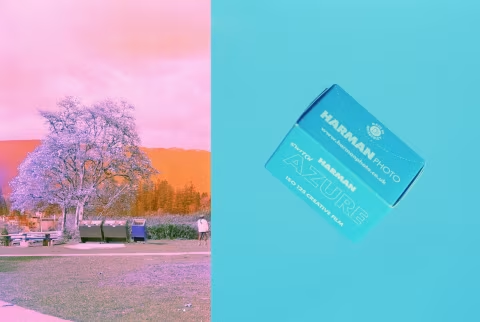
Harman Switch Azure 125 is a colour-negative film with reversed blue and red channels.
This is a brand-new emulsion, made at the UK factory, the same one that makes Ilford stuff. The colours and textures it offers are like nothing else in the world, and yet it already has a competitor.
In this review, I’ll demystify this film’s properties and origins, share lots of high-res samples, and offer a few tips for making better photos.
In this review: A brief history of Harman colour films. Switch Azure halations & colours. Contrast, dynamic range. Exposure tips. Grain, resolution, sharpness. Developing Harman Switch Azure at home. Scanning and editing. Harman Switch Azure 125 vs. Lomochrome Turquoise XR. Where to buy Switch Azure. Support this blog & get premium features with GOLD memberships!

A brief history of Harman colour films.
Harman Technology Ltd., the company that makes all the classic Ilford black-and-white films, has been exploring and experimenting with colour-negative films based on its XP2 Super, a black-and-white film compatible with the C-41 colour chemistry.
The company’s first colour-negative film since the 1960s was launched on December 1, 2023. Unlike Kodak and Fujifilm, the photographic giants who have been perfecting their colour formulas since the 1930s and 1940s, Harman had effectively zero experience making colour-negative emulsions — but they have the tools and some of the best expertise in the world to make black-and-white film.
Harman Phoenix is a colour-negative film with a purple mask, known to be difficult to scan. It’s grainy, and its colours can range from realistic to oversaturated, halated, or blown out — depending on light, exposure, and other settings. A vivid departure from the company’s portfolio of traditional and precision black-and-white films.
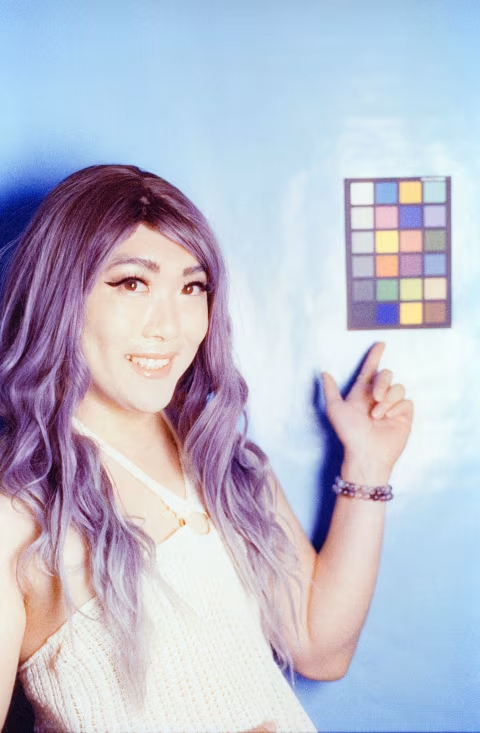
Harman Phoenix II was a July 2025 update to the emulsion that changed some fundamental properties of the film, including the colours. The company mentioned that they update their colour films regularly; thus, you may even find differences between batches.
Amid all that development (which notably follows a massive investment by the ownership in the medium’s future), the company also released modified versions of its Phoenix film. The first variant was Harman Red — a redscaled version of Phoenix I.
But redscaling film isn’t difficult to do at home — in fact, I’ve redscaled Aerochrome and Lomochrome Turquoise with good results, which is why Harman’s newest modified Phoenix variant is so interesting, as it offers something completely new.
The pink skies and blue skin rendered by the new Harman Switch Azure 125 are the result of chemical colour coupler manipulation within the thin strip of film itself, which is only possible on the factory floor. And since this new film is based on the Phoenix colour films, you will notice some similarities between the “normal” and the “switched” versions:
Harman Switch Azure is a high-contrast, grainy film with very vivid colours and halations in blue (!) but a limited dynamic range.

Switch Azure halations & colours.
Switch Azure switches the blue and red colours, yet it’s not the first film to do that. What makes it unique is how it renders the colours after switching them.
The film is highly saturated, a signature look of its founding Phoenix emulsion. Azure’s greens and the reds are very punchy, although I should say that neither channel offers high colour depth. For example, pine needles, blades of various grasses, and tree leaves may be depicted in the same shade of green.
The Azure blues are particularly interesting. Whereas the film’s design will render natural reds in blue, the underlying emulsion’s strong halations are strikingly azure.
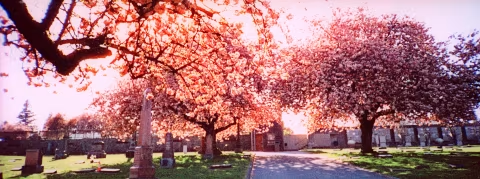
The orange halos around bright lights on films like CineStill 800T and Harman Phoenix, a result of total internal reflection, are rendered blue by Azure due to the blue-red channel swap.
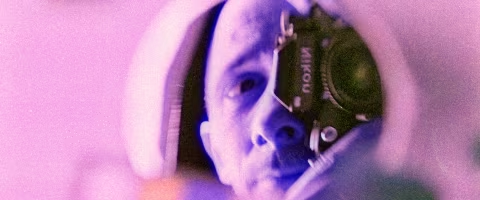
I found this effect particularly appealing for my photos of blossoming trees during this year’s early spring in Vancouver. White blossoms can appear immensely bright on this film, which in turn shifts their colour to blue. A fun and unexpected departure from the numerous effects experimental films have offered us thus far.
Contrast, dynamic range.
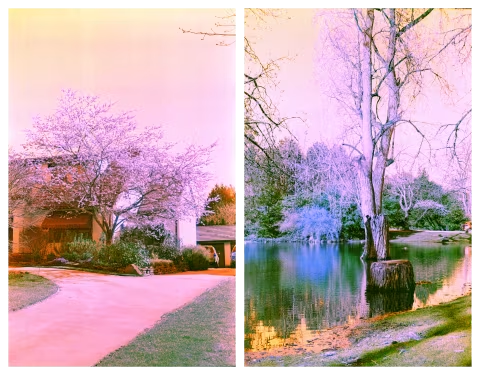
Harman Switch Azure is a high-saturation, high-contrast film. Made with the same components as the original Phoenix film, this emulsion can exhibit pronounced nose and colour shifts in shadows and highlights, especially if it’s under- or overexposed.
While Harman does not publish the characteristic curves in its Switch Azure datasheet, this film appears to have a narrow dynamic range of about 5-6 stops, similar to Phoenix. You should expect the same level of contrast as with slide and instant film.

Exposure tips.
Practically speaking, high-contrast/low-dynamic-range film means you must be careful with scenes that span a wide range of brightness (deep shadows and bright, sunlit highlights). Even with perfect metering, you may still lose detail in parts of your image.
Switch Azure’s shadows are often full of texture (sometimes expressed as green noise), and the highlights render pink casts. Whatever your intention with this film may be, I recommend metering for the middle grey or erring on the side of overexposure to avoid excessive noise.
You may also like to choose high-key scenes for this film (i.e., minimal shadows) for a silkier look — the medium format may also offer some smoothing qualities.

Grain, resolution, sharpness.
Harman colour-negative films are very grainy, and Switch Azure is no exception. The shadows are very noisy, more so than those with much faster films, such as Kodak Portra 800.
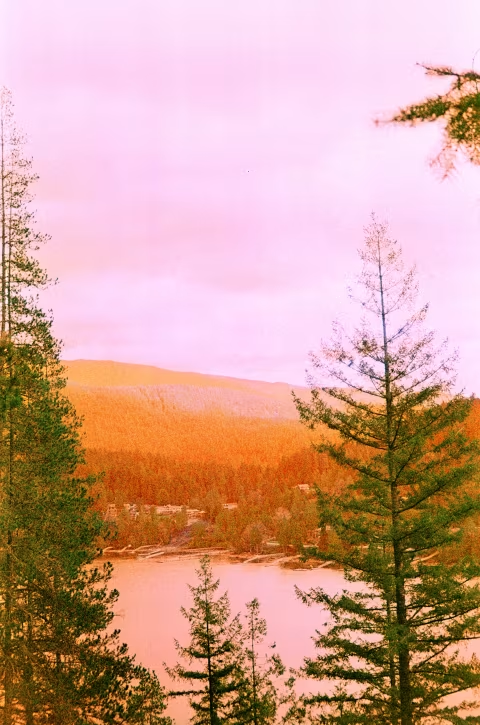
But if you follow the exposure tips above, you may be rewarded with softer colours, textures, and even an increase in resolution: one of the photos above shows a significant difference in clarity between the bright features of distant houses and the dark trees, which are barely legible.
Developing Harman Switch Azure at home.
If you’ve never developed Harman colour-negative films, you’ll find that the first few soaks will run bright yellow, which is normal. There are no issues developing this film with other C-41 films.
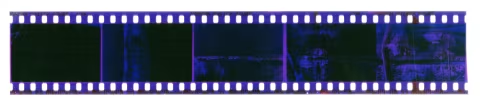
The negatives dry relatively flat; however, they will look very purple once dried.
Scanning and editing.
Because Switch Azure is a false-colour film, it provides a context of no expectations in terms of colour accuracy. You’re welcome to apply all kinds of edits to this film, and it will continue to look strange. While extreme contrast and hue adjustments will add noise and digital distortion as with any other film, the artifacts may not be as noticeable as on a smooth, colour-accurate canvas (which this film is not).
My most common edits are Colour Balance adjustments with a boost to the blue channel in the highlights and a shift to yellow in the shadows. This adds a light candy hue to the skies and reinforces colour separation with the earthy tones.
Harman Switch Azure 125 vs. Lomochrome Turquoise XR.
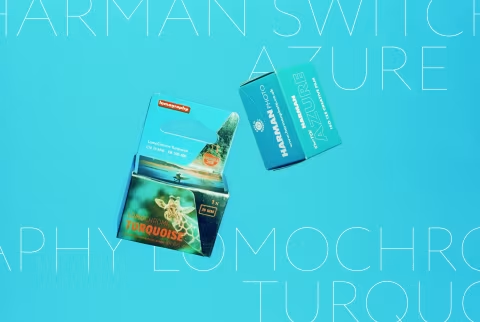
Switch Azure isn’t the first or the only film to switch red and blue colours. Savvy film photographers will recognize Lomochrome Turquoise XR, a film that’s been in production for several years, which works on the same principle.
But those are not the same films. Their colours, grain, tolerance to overexposure and underexposure, as well as bluescaled variants, differ significantly.
So which film is better?
Last month’s article compares those films side by side under normal and extreme conditions so you can see for yourself: “Harman Switch Azure vs. Lomochrome Turquoise.”
Where to buy Switch Azure.
Harman (or Ilford) films are usually some of the easiest to find, no matter where you are in the world. While Switch Azure is an experimental emulsion that may not be suitable for everyone or every occasion, it is not a difficult film to find online and at many local shops.
As of spring 2026, boxes of 35mm/36exp. sell for around $13. This film is also available in medium format (120) for about $11.
❤ Please consider making your Harman Switch Azure 125 film purchase using this link so that this website may get a small percentage of that sale — at no extra charge for you — thanks!
