Nikon F Film Camera Review
An SLR That Changed Photography
16 min read by Dmitri.Published on .

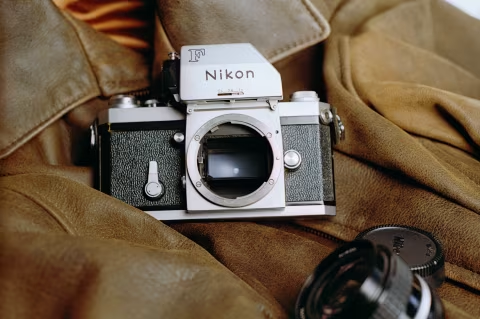
Nikon F was the first in a series of precision modular SLRs that made Nikon one of the most recognized names in photography. This camera literally stopped a bullet — and saved a life.
Its all-metal chassis is hefty and a little crude-looking — yet it’s full of technology that was revolutionary for 1959, much of which is still in use today.
A testament to design, reliability, and engineering, many copies of the Nikon F are still sold today in perfect working condition. These cameras can even fit many modern Nikkor lenses on the world’s longest-lived SLR lens mount: the Nikon F.
In this review, I will introduce this camera, its features, its place in history, along with tips for a better experience and my honest opinion on using the Nikon F as a daily shooter.
In this review: Technical specifications. A place in history for the Nikon F. Build quality. The F in use: design and ergonomics. The Nikon FTn Photomic metered finder. Is the Nikon F a good everyday carry camera? Sample photos from the Nikon F — plus a word about the Nikkor lenses. How much does a Nikon F cost, and where to find one. Support this blog & get premium features with GOLD memberships!
Technical specifications.
Production run: 1959-1973 — 862,600 units (superseded by the Nikon F2).
Lens mount: Nikon F — pre-AI (requires lenses with rabbit ears to couple with the metering system).
Metering: Through-the-lens coupled match-needle metering prism.
Focusing: SLR with interchangeable focusing screens.
Shutter: 1-1000s titanium-curtain focal-plane all-mechanical shutter. Uses a non-standard shutter release cable.
Batteries: Optional — for metering prism only, not required for operation — 1.3v mercury oxide; today you can use the WeinCell MRB-625 as a safe replacement.
Flash sync: 1/60s (requires PC sync cable or cold shoe adapter).
Dimensions: 146mm × 102mm × 95mm (4⅗” × 2⅖” × 1⅖”) 1049g (2.31lb) — with Tn or FTn finder.
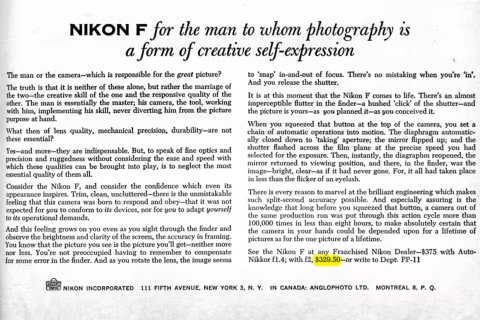
MSP: $329.50 with Auto-Nikkor F2 and eye-level finder (no metering prism). That’s approximately $3,780 in 2026 dollars.
The Nikon F was a very expensive camera and remained so throughout minor line updates until 1970, when it sold for $458.00 with a 50mm f1.4 lens and FTn finder — $3,942 in today’s value.
Above: 1960 Nikon ad with price. Scanned by Nesster (Flickr). Crop and highlight mine.
A place in history for the Nikon F.
The Nikon F is widely considered to be one of the most important cameras ever made. It served reporters on the front lines in Vietnam during the war — having saved at least one soul by literally stopping a bullet — in space, and everywhere else an advanced photographic system was needed.
It was an expensive camera, yet that price was fully justified. The F combined the best features of the period into a camera that was quick to operate, compatible with a wide range of lenses, finders, film winders, scientific and broadcast equipment, and exceptionally reliable. While its only novel design was a 0.02mm-thick titanium shutter curtain, which was incredibly light and durable — allowing the incredible for the time 1/1000s top shutter speed — the camera came with instant mirror return (other SLRs of the time, like the Zeiss Ikon Contaflex, require advancing to the next frame to unblock the viewfinder), wide-open aperture composition (for a bright, easy-to-focus view), interchangeable viewfinders and screens, and an outstanding bayonet-style lens mount.
Before the F, SLRs were a new development with great potential for macro and telephoto photography (which does not work with a rangefinder); however, they were largely slow and not particularly reliable. For example, Zeiss Ikon Contaflex, an SLR series popular in the 1950s, would completely block the view once a photo was taken, which could only be unblocked by advancing to the next frame. The Contaflex’ lens mount isn’t nearly as versatile; there are no interchangeable screens or finders, and the selenium meter is very limiting, as it would not work in telephoto situations.
Instant mirror return and interchangeable finders were available on other cameras in the 1950s, yet none combined all those essential features that made photography as quick and versatile as it has become after the F entered the scene.
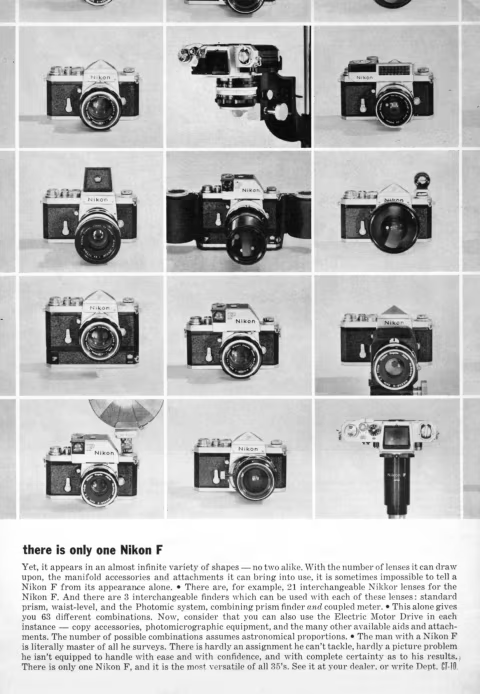
During its fourteen years in production, the F had evolved significantly. The first few did not use a titanium foil curtain, resorting to the more fragile cloth shutter as the more advanced part was nearing the end of its development. Through-the-lens metering was not available either: a detachable selenium meter was mounted to aid metering for up-close and landscape scenes (which was not as helpful for telephoto or macro shots). But as development progressed, the Nikon F did too.
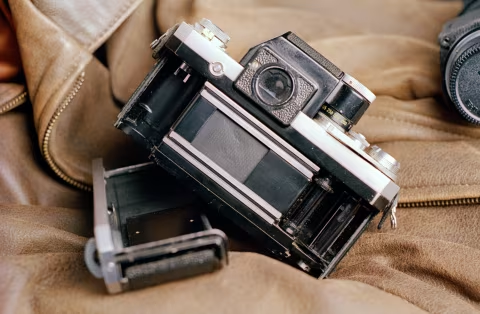
The F was developed during the fierce post-war competition between German and Japanese manufacturers, which at the time focused on rangefinder systems. The SLR was born out of the already successful S-series rangefinders, by having their bodies modified to accommodate a larger lens mount and an interchangeable viewfinder. The greatest similarity that remained a part of this camera was the removable film back (until the F2 was introduced, making film loading faster with a hinged door).
While Nikon gradually shifted to using the Z-mount lenses in the early 2020s, the F-mount, first released in 1959, remains the longest-lived standard, having been in production for over sixty years with the largest collection of lenses, topping 400 for Nikkors only (and many more made by third parties).
Though it was apparent that Nikon took the development of this camera with utmost seriousness, I doubt they expected this invention to have such an incredible impact on photography and human history.
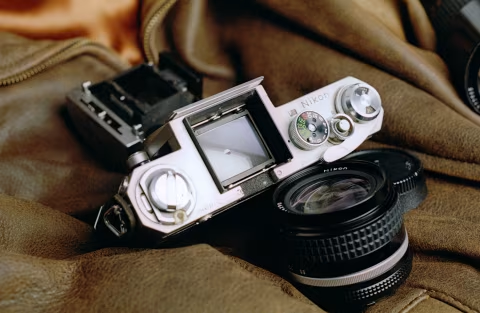
Build quality.
The Nikon F was considered to be the best-made SLR of its time. More than half a century later, it is still an impressively solid and reliable camera. Though the bulkiness and the blockiness of the hefty metal components squarely date it to the post-war manufacturing standards.
Everything fits and works perfectly on my well-used copy, yet it still reminds me of the old tube radios that my grandparents used to have in the house — well-made yet not nearly as streamlined as tools made just a few decades later.
Even the F2, which debuted in 1971, feels much friendlier in hand than the original F. I feel like this could be a strong indicator of the advancements at the company and in the world of gadgetry that occurred throughout the 1960s.
The original F was built to withstand jungle humidity, gruelling climbs up Mt. Everest, and the g-forces of going up to space. In good condition, these cameras may last another hundred years, but time can be more damaging than any one-day mission, which is why my copy would occasionally skip a frame.
Thankfully, being completely mechanical, the F may be easier to repair than some other electronic-laden devices. After such repairs, I would expect it to be as reliable as it ever was.
The F in use: design and ergonomics.
Though the Nikon F was a revolutionary camera that changed the way we do photography, it wasn’t perfect (no camera is).
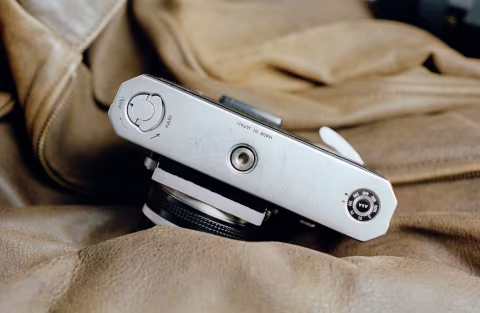
The F has everything it needs to be an outstanding companion, yet there are some things, like the film speed reminder on the bottom plate, that it could do without. This reminder is not connected to the metered prism in any way. There are much better tools for tracking film across cameras today, like the Film Log app.
Having to remove the back cover to load film is a little more cumbersome than using a hinged door, but it’s not a big deal. The action is smooth, and the lock on the bottom plate feels very secure — no amount of dropping will cause the exposed film to spill out.
The camera is hefty, but it’s not unruly. It handles reasonably well as all the controls are in the right place — and there aren’t too many of them.
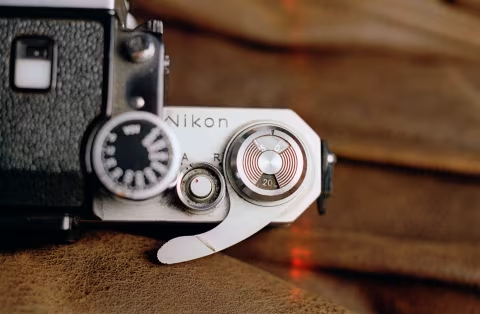
A couple of helpful hints: the shutter button has a red dot that rotates when the film is properly loaded. If your roll didn’t catch the spool properly, the dot would remain stationary — a signal to reload and avoid the disaster of shooting 46 frames of nothing. The ring around the shutter button has two positions: A (the normal shooting position) and R (unlocks the film rewinding).
The shutter button on the F is well-balanced and easy to feel; with some practice you’ll know exactly when it’ll fire, allowing you to time the shots perfectly.
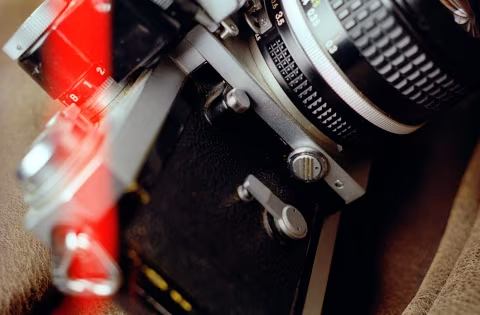
The film counter window is conveniently right above the film advance lever, which moves smoothly (although not as buttery as on the F2). The lever on the F uses a 15-degree standoff, which lets you keep it slightly away from the body for an easy way to advance the film to the next frame; however, it was not until the F2 when this feature became a power switch for the meter — on the F you will need to use the button on the side of the finder to switch it on.
If you’re shooting long exposures or using specialized lenses that require it, you can enable the mirror lock-up by rotating a small knob on the front of the camera located directly on the mount (it looks like a button). Once you cock the shutter, turn it so that the red and black dot aligns, then your mirror will stay open for the duration of the shot to help avoid the vibrations. The function will reset after the shot is taken.
If this is your first Nikon SLR, you may find that mounting lenses on this camera is done backwards compared to almost all other models. The lock button is on the right side (when looking directly at the lens) and the bayonet mount requires you to turn the lens clockwise. I’ve been shooting Nikons for years and only now am I getting used to mounting them this way.
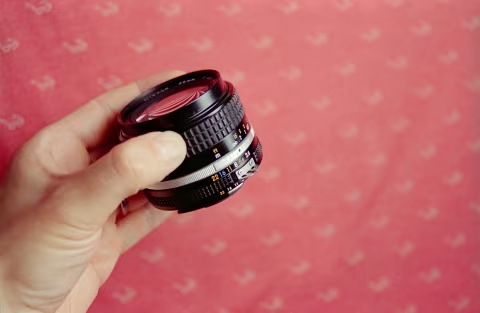
Another thing to know about the F (and the F2 also) is that in order to couple the lens to the metered prism, it will have to have the “bunny ears” piece on the lens. Once mounted, you’ll also need to walk the aperture on your lens from min to max f-stop to ensure the camera has mechanically “learned” what you’re using. While not entirely convenient, there are ways to modify many of the later Nikkor lenses to be useful with those cameras. Still, you would also need to consider the batteries for the meter. If the lens does not have the metal catch bracket, it’ll still work on the F just fine (with some exceptions).
While the “bunny ears” may be putting a damper on some lens options for this camera, the choice is so vast and modifications are not particularly difficult that I really don’t think it should be considered a significant downside. I will, however, talk about some things I did not love about using this camera further below.
If you want to use flash with this camera, you will need either a hot shoe adapter, which would slide over the film rewinder crank, or to connect one via the PC sync socket. There are many more accessories for this camera, including a motorized film transport (from the 1960s!), and extended film magazines that could keep 200 frames’ worth of film.
Still, the most important one (aside from the lenses) is the interchangeable viewfinder.
The Nikon FTn Photomic metered finder.
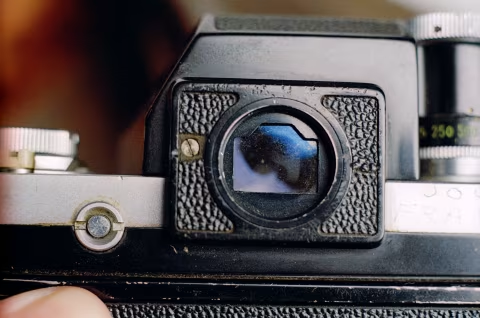
Throughout its fourteen years on the market, the camera had its share of finder designs. Earlier versions of the finder did not use through-the-lens metering; they worked just like the meters on many older rangefinders that metered the scene from the body. This made measuring light a bit of an ordeal with telephoto and macro lenses. The finder that arrived on top of my F was the Nikon FTn — the company’s best design (until the Nikon F2’s advancements that followed).
I loved my Photomic finder on the F2. It’s very comfortable, very large, and even though the metering isn’t as precise as I want it to be, it’s a lot of fun to watch the needle move in a little pill window. The F’s FTn is not like that. It’s just as heavy, but it needs specialized batteries; it’s not as bright, it’s not as comfortable, and it’s not as fun. (Although, of course, it’s not as dim or small as most cameras of the period — it was the F, after all, and, as you can see from the photos, even the finder optics used coating to maximize light transmission, a rarity in the 1960s).
Unlike the F2, which is turned on by propping the film winder out of the body slightly, the metered prism finder on the Nikon F also has its own power control buttons — on the side to the right for ON, which pops the button on the top as a reminder to turn it OFF to avoid draining the batteries.
The unmetered prism finders are significantly more expensive today for some of the reasons mentioned above. There are no batteries to fiddle with, and the camera is lighter without them. Still, there’s something about the look those gadgets give the Nikons that no other camera that had ever been created could match. It’s a classic.
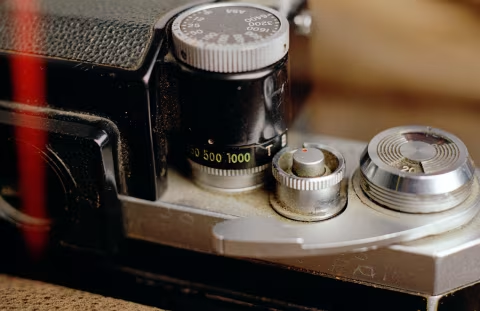
The metered prism finders for the F and F2 have a unique functionality in that they couple with the shutter by sliding directly above the shutter speed selector and taking over that action. As with the aperture, which you would need to shift back and forth once you mount the lens, the finder will require rotating the speed selector until it latches on. They also use center-weighted metering, which means that the preference will be given to things that are most likely to be the most important components of your picture — but in either case, the metering needle in your finder will simply tell you how much you are off from your best guess.
Given the age and the issues with those finders, I think most people can learn to guess the light much better just by looking at the scene.
Removing the finder requires pressing the small button (just above my finger in the photo above — it’s usually quite tight!), and then releasing the two latches at the front; mounting it back requires placing it on the body and pressing down firmly. Tricky at first but very easy after you’ve done it a few times.
Interestingly, the focusing screens are interchangeable between the F and the F2, and you can even match the finders between the cameras somewhat — although they may not stay securely and require removing a name plate (certainly not recommended, but if you find a camera with a name plate missing on the finder, you’ll know why).
Is the Nikon F a good everyday carry camera?
The answer to this question depends on what you want from your camera, and how you expect to shoot it.
The Nikon F is a fairly heavy camera. The metered prism is not awfully dependable, although it could be serviced and modified to work with regular LR-44 batteries like new (the circuit is not terribly complex for an experienced technician). Though it certainly looks very cool — and you could get a copy with an unmetered prism for weight reduction.
The camera itself is incredibly dependable. My copy had a slightly crumpled shutter and many, many dings, yet it had no issues with making correct exposures when I metered my scene right. You may find that cameras in particularly meek conditions would have slow shutter speeds and require repair, which is totally possible even today with the right person.
Nikon Fs are the cheapest of the pro-level Nikon SLR series, and they carry more historical value than the rest of the lineup. Folks in the know will notice. They are also dependable — but I’d still consider more compact Nikons like the FM2, which may have a sliver less coverage (a slim border around the actual frame exposed on film will be obstructed by the viewfinder’s frames) but are just as dependable, have better metering, and are much lighter.
Still, if you want a camera that literally built the modern world of SLRs, there’s only one: the original F. If you maintain it and are OK with the heft and slight inconveniences, it may last a hundred more years.

Sample photos from the Nikon F — plus a word about the Nikkor lenses.
While the Nikon F has certainly enabled these images, most of the credit should probably go to the Nikkor lenses that focussed the light for it. There is an immense selection of glass for those cameras all of good or outstanding quality.
In fact, I prefer the Nikkor brand (Nikon’s sub-brand used on virtually all of its SLR lenses) to all other options for the quality and the materials. For example, Canon’s optics of the time may be considered just as good, yet they use a lot more plastic components that make them feel cheap. That doesn’t have to be a bad thing, of course, as that makes them lighter; it’s simply my preference to handle cool metal parts that I know are easier to repair and maintain.



How much does a Nikon F cost, and where to find one.
The Nikon Fs sell at a fairly wide range of prices in 2026: from $75 for a body in an unknown condition to $600+ for perfectly maintained black bodies that look like they rolled off the belt yesterday. The majority of those cameras can be found on eBay (see link below), although you may find copies on other marketplaces and even at the local fairs.
See this guide for shopping vintage cameras to improve your chances of getting something that will last and is priced fairly.
❤ Please consider making your Nikon F camera purchase using this link so that this website may get a small percentage of that sale — at no extra charge for you — thanks!
