Film Photography News — July 2026 Recap
The Mystery of 🇪🇺 EU’s Only Colour-Negative Film Factory, 2 New Cameras, Film Prices, and Better Film Scanning 🎞️
9 min read by Dmitri.Published on .

☞ This is the 88th monthly analog.mom Newsletter with the latest film photography lore. Sign up to get it via email on the last Tuesday of every month (it’s free).
TL;DR: Optik Oldschool bought ORWO, Kodak EC35 is a new $35 film camera with an action like the Olympus Mju I, Lomography releases a Simple Reloadable Half-frame camera, the growing global film price divide, and app updates.
Get exclusive film photography scoops, learn advanced techniques, science, history, and access powerful web apps for inverting negatives, tracking rolls, and more with the analog.mom GOLD memberships.
In this newsletter: Optik Oldschool buys ORWO film manufacturer — 🇪🇺 EU’s only colour-negative film factory: the history, the mystery, and what it means for film photographers today. The global film price divide. What happens when you shake a Polaroid picture? RETO releases Kodak EC35, an affordable clamshell film camera. Lomography’s Simple Reloadable Half-frame camera. Predictable automatic colour correction for film scans. Lifetime GOLD membership giveaway. Download and print this newsletter. Latest on analog.mom. Support this blog & get premium features with GOLD memberships!

Optik Oldschool buys ORWO film manufacturer — 🇪🇺 EU’s only colour-negative film factory: the history, the mystery, and what it means for film photographers today.
Did you know that Polaroid uses ORWO film in its frames?
Or more accurately, Polaroid B.V. (located in the Netherlands 🇳🇱) uses negatives coated by InovisCoat GmbH (a German factory 🇩🇪 that sometimes sells ORWO-branded films) in its frames as a key, but not the only, component.
How do I know this? Someone’s comment on my list of the world’s remaining 21 film factories directed me to a YouTube video where the Senior Vice President Film Manufacturing at Polaroid, Andrew Billen, mentioned that “all the materials come from our plant in Monheim” — which is a town in Germany, home of InovisCoat.
According to Kosmo Foto, Wikipedia, and sometimes this blog (though not officially confirmed), InovisCoat makes colour-negative films for several brands, including Lomography. The new OptiColour 200 (also sold as KONO Color 200, visually similar to Lomography’s Color’92 and Classicolor) would be their latest and best-known product, although the factory had also previously sold their ISO 400 colour-negative film directly under the brand ORWO NC 500.

ORWO is a brand with 117 years of history. When I visited my grandparents’ home in Moscow back in 2019, I found a treasure trove of Soviet-era film slides with the ORWO brand stamped in the margins from a period when the factory produced film in East Germany.
Today, the ORWO brand is split in two. In Germany, it’s ORWO Net AG, which sells prints and other materials — it recently became insolvent. But beyond the country’s borders, the ORWO brand has been operated by Jake Seal (his story gets murky) and associated with FilmoTec GmbH (a German black-and-white film manufacturer that sells Wolfen-branded films) and InovisCoat GmbH.
The latest twist in the story of German photographic film manufacturing — the only factory in Europe aside from Harman that makes colour-negative film — is the acquisition of both FilmoTec GmbH and InovisCoat GmbH by Optik Oldschool, a German film lab known for its OptiColour 200 film.
While the exact source of funding required to buy two film factories is not revealed, Optik Oldschool is operated by Chris Vandebroek, who made his money distributing video games.
(You can learn more about the sale of those factories here.)
I think it’s unlikely that the ORWO brand is part of the sale to Optik Oldschool, as it’s not mentioned anywhere in the company’s announcement. According to ORWO Medical, the name is used for “technology, real estate, entertainment, scientific coatings, R&D, engineering, archiving and a range of advanced 3D applications - printing, scanning and displaying,” suggesting that its current owner is unlikely to give that up just yet.
In short, the ORWO brand seems to have finally completely decoupled from its roots in film manufacturing, whereas all the German-made films and many essential components used by other photographic brands may soon be made by Optik Oldschool.
One more piece of news before I move on to the next topic: this recent purchase of FilmoTec and InovisCoat by Optik Oldschool is not the first for that company: the curiously-named Finnish SantaColor brand, which specializes in selling films hard or impossible to find, announced its sale to Optik Oldschool late last year.
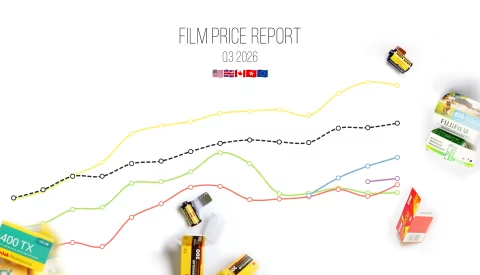
The global film price divide.
The latest analog.mom Film Price Report was quoted by PetaPixel, Kosmo Foto, and Digital Camera World. In it, I shared an updated survey of film prices across 13 stores worldwide, tracking 37 film stocks since 2018.
A quote by one of the PetaPixel readers colours the findings in that report: “Maybe the problem is not how expensive film is. Maybe it’s more about how much the price of energy, food and accommodation has increased, and how little is left over for photography.”
Indeed, the price of film didn’t change all that significantly compared to January 2026. It did go up by a grand average of 2.5%, but the previous 6-month period saw a 0% price increase — meaning the 2.5% price hike can be spread over 12 months, making it lower than the average healthy rate of inflation for all goods.
Read the full report here: “The Growing Global Film Price Divide: Film Price Report Q3 2026 🇺🇸🇬🇧🇨🇦🇭🇰🇪🇺.”
The report goes into further detail on which films are better or worse deals to buy today and spots a new trend: the cost of photography can now vary significantly based on where you live.
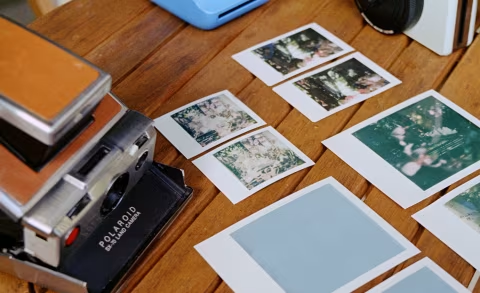
What happens when you shake a Polaroid picture?
Some will tell you to never; others will instinctively wave the frames as soon as they roll out of the camera. Yet no one had ever taken the same photo twice and run an experiment to show what would actually happen if you shake vs. not shake the Polaroid (or any instant) photo as it develops.
In this month’s mini-experiment, I compare Polaroid SX-70, Polaroid Go, and Instax Mini frames to see if shaking them might damage a photo — and if so, how much?
Read: “What Happens if You Shake a Polaroid Picture?”

RETO releases Kodak EC35, an affordable clamshell film camera.
RETO’s follow-up to their very successful Kodak Snapic A1 is the Kodak EC35: an affordable ($35) reusable camera with a unique clamshell design.
Reminiscent of the Olympus Mju I, the slide cover is rare or nonexistent on simple, cheap plastic cameras. It’s fun, and it helps keep the lens safe from scratches and debris. But that’s where the similarities between the two cameras end: the Mju sells for north of $200 today as a vintage point-and-shoot camera with great features such as automatic film transport, autofocus, variable shutter speeds and a fantastic f3.5 Olympus glass lens. Alas, the vintage gadget can break fairly easily with little to no repair options.
Read more about RETO’s Kodak EC35 film camera here.

Lomography’s Simple Reloadable Half-frame camera.
Whereas during the previous several years I saw an influx of attempts at mid- to high-priced camera designs by Lomography, MiNT, Pentax, and others — this year I’m seeing many cheaper new cameras enter the market.
Lomography’s Simple Reloadable Half costs less than $30 (with film!) and takes twice as many photos on regular rolls of 135. It’s a deal that may be hard for anyone to beat.
Read more about this camera and see more sample scans here.

Predictable automatic colour correction for film scans.
Regular analog.mom readers already know about film Q, a one-click web-based batch film inversion tool for camera RAW & TIFF negative scans that uses image-processing techniques I’ve explained in detail on this blog.
The app had recently undergone significant upgrades, and one of its newest features is an automatic colour correction step based on the Gray-World scientific assumption about human perception. Similar to the reference grey mask method, it attempts to balance each scan so the colours look more natural — with several logic checks to avoid making the image worse or overshooting the corrections.
The result is cleaner scans without any input or additional controls to worry about.
film Q is included with all analog.mom GOLD memberships; it works well for inverting negatives and fixing expired film scans.

Lifetime GOLD membership giveaway.
In celebration of the 200th year of photography (1826-2026), I’m giving away FOREVER-FREE lifetime passes for analog.mom GOLD memberships!
There are 12 of them, announced monthly in this email — throughout 2026 only.
This month’s winner of a lifetime GOLD membership on analog.mom is:
Ryan 🎉🥳
Congrats to you! I’ve applied a perpetual 100% discount to your account so you can enjoy all the analog.mom features for $0/mo going forward.
GOLD memberships include access to web apps for negative inversion and chemical logging, all articles on this website in printable PDF format, and exclusive film photography content.
You, the reader, can also win this prize. To enter, you just need to be an existing member or sign up!
Download and print this newsletter.
GOLD members can download this newsletter as a high-resolution PDF file. Open this newsletter in your browser and click the “Download PDF” button at the top.
Hope you found this email a helpful and fun read. Feel free to add a comment or reach out anytime. 👋
