Rollei Infrared Film Review
Samples, Tips, and a Short Guide on How to Shoot This Film for Best Results
11 min read by Dmitri.Published on .

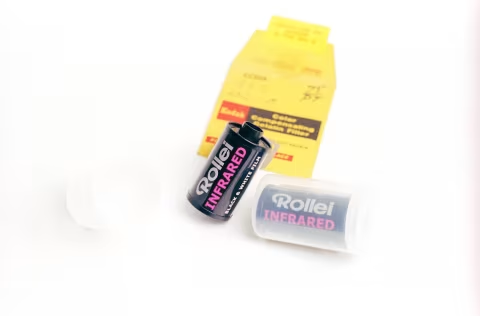
Rollei Infrared ISO 400 film can create a range of looks, from medium-speed, medium-contrast black-and-white exposures to surreal scenes with glowing foliage, thanks to the Wood effect with the help of a strong red filter.
In this review, I’ll briefly explain the basics of infrared photography and the requirements for shooting this film, list the technical specifications, share my opinion on the overall quality, and offer tips for better results.
In this review: What infrared film actually sees. Filters and exposure calculations for shooting Rollei Infrared film. Composing and focusing with infrared film. IR contrast & dynamic range. Grain, resolution, sharpness. Home development. How much does this film cost? Where to buy. Support this blog & get premium features with GOLD memberships!
What infrared film actually sees.
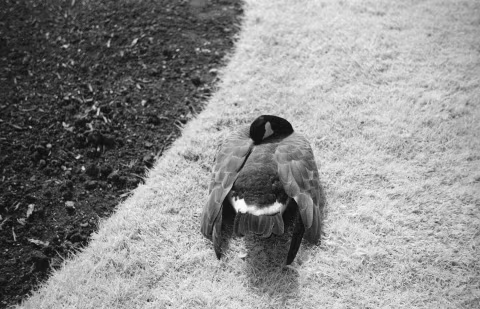
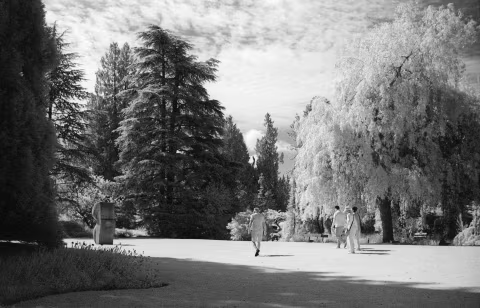
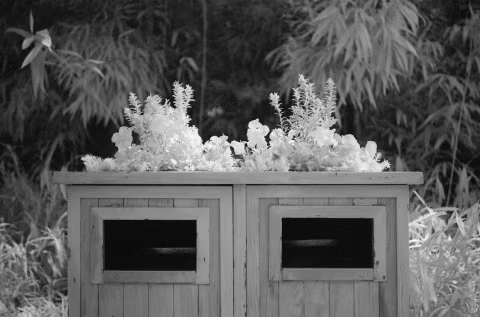
You may recognize images shot on infrared film or on a modified digital camera sensor by the way they render leaves, grass, and foliage. If it’s black-and-white, like the Rollei Infrared 400 I’m reviewing here, the greens will glow white — and if you do it right, the effect will be much stronger than anything you could achieve with a green filter and orthochromatic film.
There are some films, like Lomochrome Purple XR, and digital editing techniques that approximate the contrast and tonality of a true infrared film, yet they never quite reach it. That’s because the simulations are designed to alter the greens to look like they’re glowing — but that’s not what the infrared film actually sees.
In fact, the world’s only colour-infrared film, Aerochrome, was designed specifically to tell apart camo green paint from foliage at great distances. Indistinguishable to the human eye or the above-mentioned simulations, green paint looked blue on Aerochrome, whereas the foliage was painted bright red, revealing enemy structures as well as areas of depleted growth in forests when the material was used for civil research.
The glowing appearance of vegetation on infrared film is called the Wood effect — not because trees are made of wood, but because this photographic technique was pioneered by Robert W. Wood.
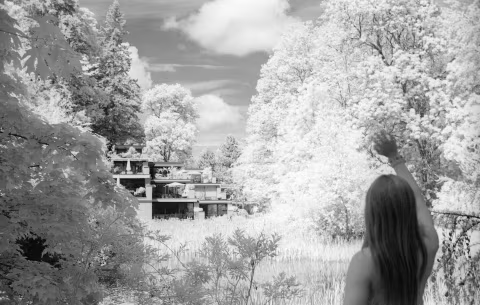
Moreover, the trees aren’t actually glowing — at least not to the extent that can be captured on film — but their leaves reflect infrared light emitted by the sun — an important aspect to understand for photography. Additionally, different species of trees and grasses will reflect various amounts of infrared light, as you may’ve noticed play out in the sample photos below.
Filters and exposure calculations for shooting Rollei Infrared film.
Light emitted at 700-900nm on the electromagnetic spectrum is classified as infrared¹. Visible light is between 400 and 700nm. Like all other IR and non-IR films, Rollei Infrared is also sensitive to visible light: the datasheet lists its range at 650-750nm.
In other words, it can work as a regular black-and-white film, but if you want the Wood effect to be noticeable, you will need to prevent the visible light from overpowering the infrared emissions. This can be done with a filter that blocks visible light while passing the IR rays through.
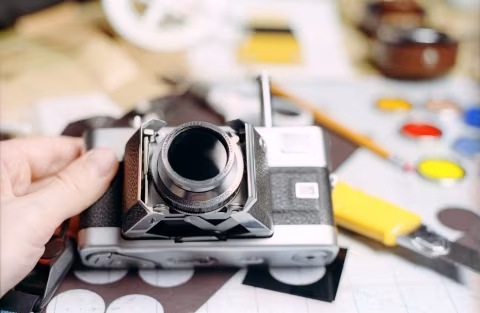
The stronger the filter, the less visible light it’ll pass, leaving a greater proportion of total rays as infrared. An orange or a red filter will make little or no difference, but a true IR filter, which looks opaque black² to the eye, will do a much better job.
However, since Rollei Infrared is only sensitive up to 750nm, the IR filter can’t be so strong that it blocks the light beyond 750nm, as that will leave no light for Rollei Infrared to work with (since its sensitivity terminates at 750nm).
Infrared filters marked Wratten 89B or R72 are typically the best choice for all modern black-and-white infrared films, like the Rollei Infrared 400. They block (visible) light shorter than 690nm, which is exactly what this film needs.
But with the filter on, you will also need to adjust your exposure. The filter factor number will tell you by how much. For Wratten 89B or R72, it’s 16, which means that it lets in 16 times less light when mounted. In stops, it’s 4 (decreasing light by one stop will let in ½ the light in, two stops is ¼, three stops is ⅛, and four stops is a sixteenth).
☝︎ Further reading: “What Is Exposure and How to Measure It” — this guide explains what stops are in detail.
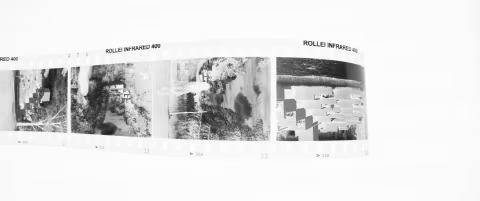
Simply put, with an 89B or R72 filter, Rollei Infrared 400 should be rated as if it were ISO 25 film (which is four stops slower than ISO 400) and developed normally (as if it were rated at ISO 400, as it says on the box).
Manual metering or using the Sunny 16 rule are the most reliable ways to expose infrared film, but you may also get good results with your camera’s built-in meter. If it’s a through-the-lens type, you don’t need to rate your film as an ISO 25, but you’ll need to check that this actually works, as not all TTL meters are the same.
¹ — 700-900nm is more precisely classified as near-infrared, but for simplicity and brevity, I’m calling it infrared in this article.
² — The 89B/R72 filter can look totally opaque, as illustrated above, and even a little blue in some light. However, if you hold it against a bright light bulb, you may see a bit of red light passing through. This is because a small proportion of visible light (~690-700nm) can still pass through it, and, as some research shows, the human eye is slightly sensitive to some near-infrared light.
Composing and focusing with infrared film.
Infrared film is typically only effective in daylight. Our sun is the strongest emitter of infrared light, enough to reflect off foliage for that Wood. Because of this, Rollei Infrared and other IR films produce the strongest effect in bright daylight, which is ideal for exposing film rated at EI 25 (an ISO 400 film, exposed as if it’s ISO 25).
According to the Sunny 16 Calculator, this could mean setting your camera’s aperture to f5.6 and shutter speed to 1/250, which are easy settings to work with handheld with most lenses. However, you will need to change how you focus your camera.
f5.6 is a wide-enough aperture to give you blurry photos on IR film without focus adjustments. This is because infrared light converges on a different plane than visible light (in fact, even visible light of different colours converges on slightly different planes, which is what the multiple lens elements are designed to fix — but that doesn’t work as well for IR, hence adjustments must be made).
Many camera lenses have a small red dot near the focusing mark on the printed scale (on the lens barrel itself). To get an accurate IR focus, you’ll need to first focus the lens, not where its focusing number is pointing (say, two meters or six feet) and then rotate the focus ring slightly so that the red dot points to the previous value (2m/6’ in this example).
My film camera didn’t have an IR focus mark, so I made an educated guess as to where it should be by looking at another 50mm lens with the red dot, and that worked fine. I’ll explain how you can do that too in a later article.
Rangefinders are typically the best type of camera to use with infrared film, as they let you focus precisely without having to look through the lens. If you’re shooting your Rollei Infrared with an 89B/R72 filter, you won’t be able to compose or focus until you take the filter off, as it’s opaque to visible light; in that case, you’ll need to take off the filter, prepare your shot, then place the filter back on, set your exposure settings, take a photo, and repeat for the next shot.
IR contrast & dynamic range.
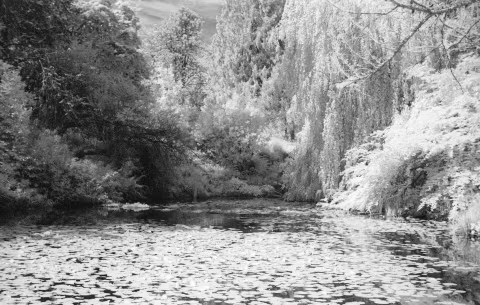
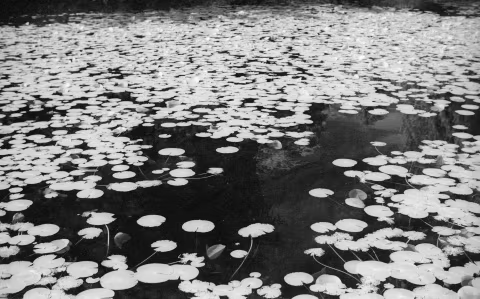
Infrared film produces higher-contrast images than black-and-white film. Some of it is due to the bright glow of the Wood effect, some is due to the fact that it’s usually shot outdoors in bright sunlight (which is already a high-contrast lighting), and some is due to the fact that IR light is absorbed extremely well by water bodies, which will appear near-black.
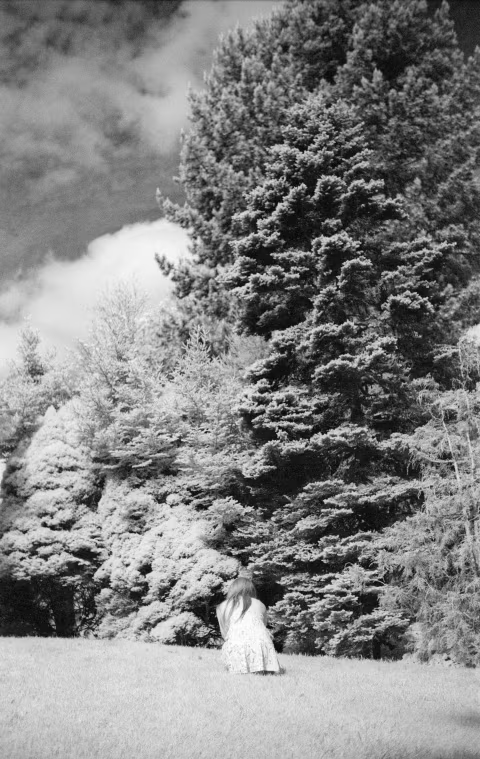
Rollei Infrared is no exception. With the filter on, it gives very punchy tones that can’t be replicated by just moving sliders around in Photoshop; even the brightest highlights retain fine details (if exposed properly) — it’s a completely different tonality and exposure than what you’ll see with any visible-light-optimized films.
Grain, resolution, sharpness.
The datasheet for Rollei Infrared 400 lists RMS 11 as a measure of its graininess. It classifies it as a fine-grained film, though that should be taken in the context of other ISO 400 films, as the grain will be noticeable on good scans with sufficient enlargement. You should be able to see some of it in the photo above on a larger screen.
The amount of grain will, of course, depend on your developer: I used Rodinal, which is known to produce fairly sharp, visible grain. There will be less grain in brighter areas or with other developers, like Ilford DD-X. Pushing this film will inevitably make it appear grainier.
Home development.
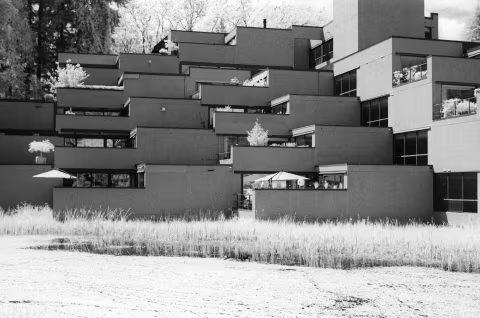
Development times for infrared film can be confusing. The Massive Dev Chart lists several times and dilutions that seem radically different from the recommendations. My understanding is that some of them incorporate the filter factor into the development process, which is unnecessary and can lead to mistakes.
I avoided using development times that involve filter calculations and instead followed the Rollei datasheet for my developer. The Massive Dev Chart is an immensely helpful resource, but it’s important to remember that it is built on community submissions, many of which are experiments by folks like you and me, not lab technicians or film manufacturers.
How much does this film cost?
Rollei Infrared is a relatively affordable black-and-white film, available in a variety of formats, including 135 (reviewed in this article), 120, large format, and even in bulk.
As of this writing (June 2026), it sells for $13 in the US per single 35mm 36exp. cartridge, $15 for a roll of 120, $100 for 25 sheets of 4x5, or $130 for a 100’ bulk roll at Freestyle Photo (a large LA-based retailer).
Where to buy.
This film should be fairly easy to find at stores that have a good selection of black-and-white films. The link below will give you a few options for online shopping (make sure to browse the linked stores if you’re looking for medium format/bulk/large format options, as they often have that as well):
❤ Please consider making your Rollei Infrared 400 film purchase using this link so that this website may get a small percentage of that sale — at no extra charge for you — thanks!
